One codebase or two? A practical guide to choosing between Flutter and native iOS/Android development for your next app.
It is one of the first questions every founder asks us: should we build the app in Flutter, or go native with Swift for iOS and Kotlin for Android? Both are excellent choices in the right situation. Here is how we help clients decide.
What Flutter is, in one paragraph
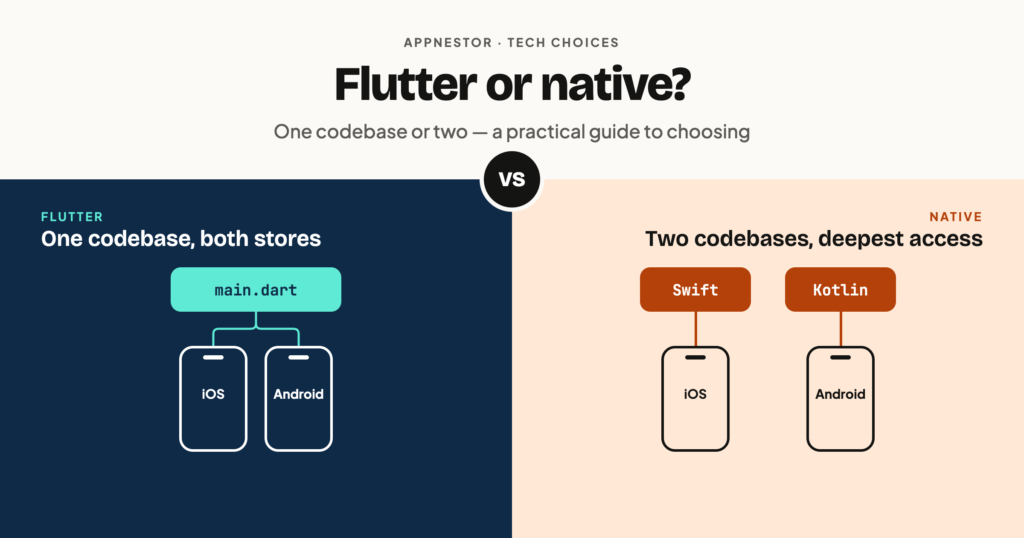
Flutter is Google’s open-source framework for building apps from a single codebase. You write the app once in the Dart language and ship it to iOS, Android and, if you want, the web and desktop. Flutter draws its own interface, so the app looks and behaves the same on every device.
What “native” means
A native app is built separately for each platform with that platform’s own tools: Swift or SwiftUI for iPhone, Kotlin and Jetpack for Android. You get two codebases, usually two sets of developers, and the deepest possible access to each operating system.
When Flutter is the better choice
- You need iOS and Android at launch. One team builds both, which typically saves a large share of the development budget.
- You are validating an idea. MVPs reach the stores faster, and changes ship to both platforms at once.
- Your app is mostly screens, forms, lists and APIs. Booking, e-commerce, fintech dashboards, learning and content apps all fit Flutter extremely well.
- You want one consistent design. Your brand looks identical on every phone.
When native is the better choice
- Heavy device features. Advanced camera processing, Bluetooth hardware, background location or deep wearable integration are easier natively.
- Platform-first experiences. Widgets, Apple Watch apps, App Clips and the latest OS features usually arrive natively first.
- Maximum performance. Games and graphics-intensive apps can benefit from going native.
- You already have native teams and want to extend an existing app.
Cost and timeline
With Flutter, you pay for one codebase, one QA cycle and one set of features. With native, you build and test everything twice. For most business apps, that makes Flutter the faster and more economical option, while native makes sense when the features above are central to your product.
Our rule of thumb: if the app’s value is in your business logic and design, choose Flutter. If the value is in deep hardware or OS features, choose native.
You can also mix both
Flutter apps can call native code through platform channels. Many of our projects are Flutter apps with a small native module for one specialised feature, which gives you the best of both.
How we decide with you
On a free discovery call we look at your features, budget, timeline and growth plans, then recommend one approach and explain why. We build in Flutter, Swift and Kotlin every day, so the advice is about your product, not our preferences.